

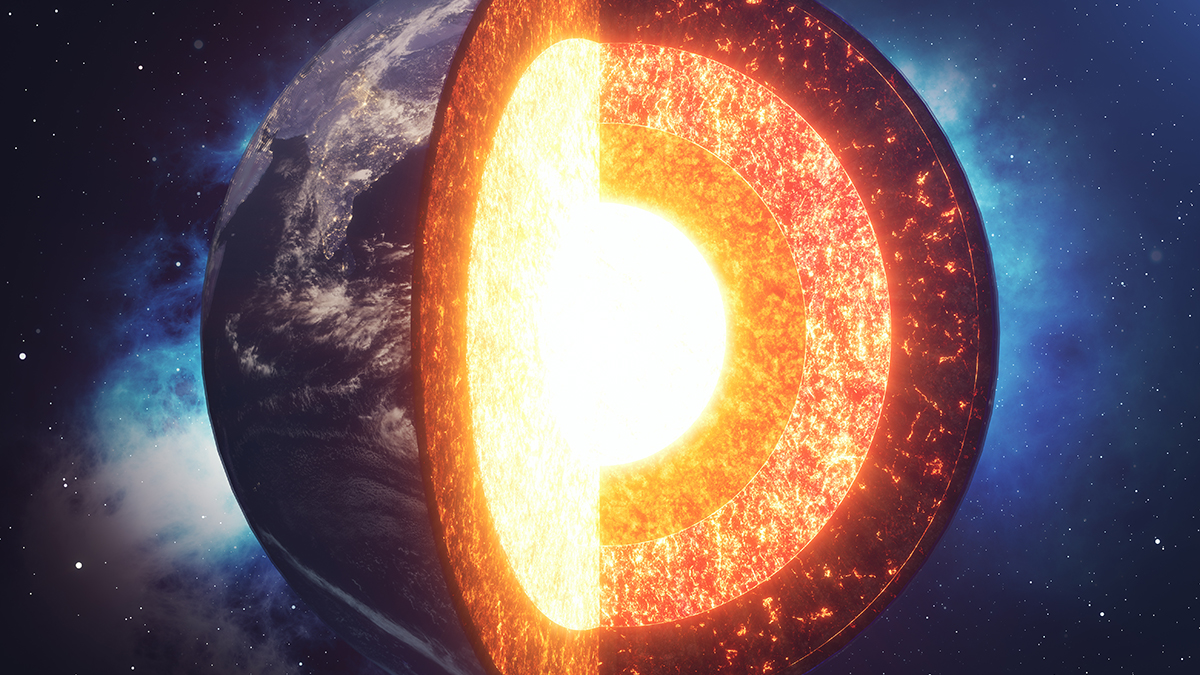
Scientists are exploring the fascinating hypothesis that Earth's inner core may harbour extreme forms of hydrogen unlike anything observed on the surface. This novel perspective on our planet's deepest layers could reshape understanding of its formation, evolution, and internal dynamics. The research delves into the enigmatic conditions at the planet's centre, where immense pressures and temperatures could forge previously unknown chemical structures.
The Earth's interior is a complex, layered structure, with the solid inner core encased by a liquid outer core, followed by the mantle and the crust. While the inner core is primarily understood to be composed of an iron-nickel alloy, the presence of lighter elements has long been a subject of scientific inquiry. Traditional models have suggested the inclusion of elements like silicon, oxygen, carbon, and sulfur. However, this new research introduces hydrogen as a significant potential constituent, existing under conditions that would render it radically different from its common gaseous or liquid states.
At the extreme pressures and temperatures characteristic of the inner core – estimated to be over 3.6 million times atmospheric pressure and around 5,700 degrees Celsius – hydrogen could undergo a phenomenon known as metallization. This means it could transform into a metallic fluid or even a solid, superionic state, where hydrogen nuclei move freely within a lattice of electrons. Such a state would possess unique electrical and thermal conductive properties, potentially influencing the Earth's geodynamo, which generates its protective magnetic field.
The implications of a hydrogen-rich inner core extend to planetary formation theories. If hydrogen was incorporated into the core during Earth's early stages, it could provide clues about the conditions and elemental distribution in the protoplanetary disk from which our planet coalesced. Furthermore, the interaction of hydrogen with iron and other core elements under extreme conditions could lead to novel alloys and compounds, influencing seismic wave propagation through the core, which scientists use to map its structure.
While direct sampling of the Earth's inner core remains impossible, researchers utilize high-pressure laboratory experiments and computational simulations to replicate the conditions found deep within our planet. These studies provide crucial data points, allowing scientists to model how materials behave under such extreme environments and extrapolate their findings to the inner core. Advanced seismic tomography also offers indirect evidence by analyzing how earthquake waves travel through and are reflected by Earth's internal layers, providing constraints on its composition and physical properties.
This hypothesis challenges established views on core composition and highlights the ongoing scientific quest to unravel the mysteries beneath our feet. As research progresses, a deeper understanding of the inner core's chemistry and physics will not only shed light on Earth's past but also contribute to a broader comprehension of planetary interiors throughout the cosmos. The potential discovery of extreme hydrogen forms represents a significant step in this scientific journey.
For Canadian readers, understanding the fundamental processes within our planet is crucial as it underpins phenomena ranging from seismic activity to the protective magnetic field that shields us from harmful solar radiation. This research, while theoretical, contributes to the global scientific endeavour to comprehend the planet we inhabit, influencing geological surveys, resource exploration, and environmental studies that are relevant to Canada's vast and diverse landscape.